
Casino table games can appear straightforward: a deck of cards, a roulette wheel or a choice between two outcomes. Yet small differences in rules and payouts can change the mathematics considerably. Two blackjack tables may look nearly identical while offering different returns for the same winning hand.
Free table game demos provide an opportunity to understand the rules without depositing money. They can illustrate how bets are resolved, what different selections mean and why payout conditions matter. The virtual balance used for practice has no cash value, and favourable demo results do not predict future winnings.
Blackjack, Roulette and Baccarat: Different Rules
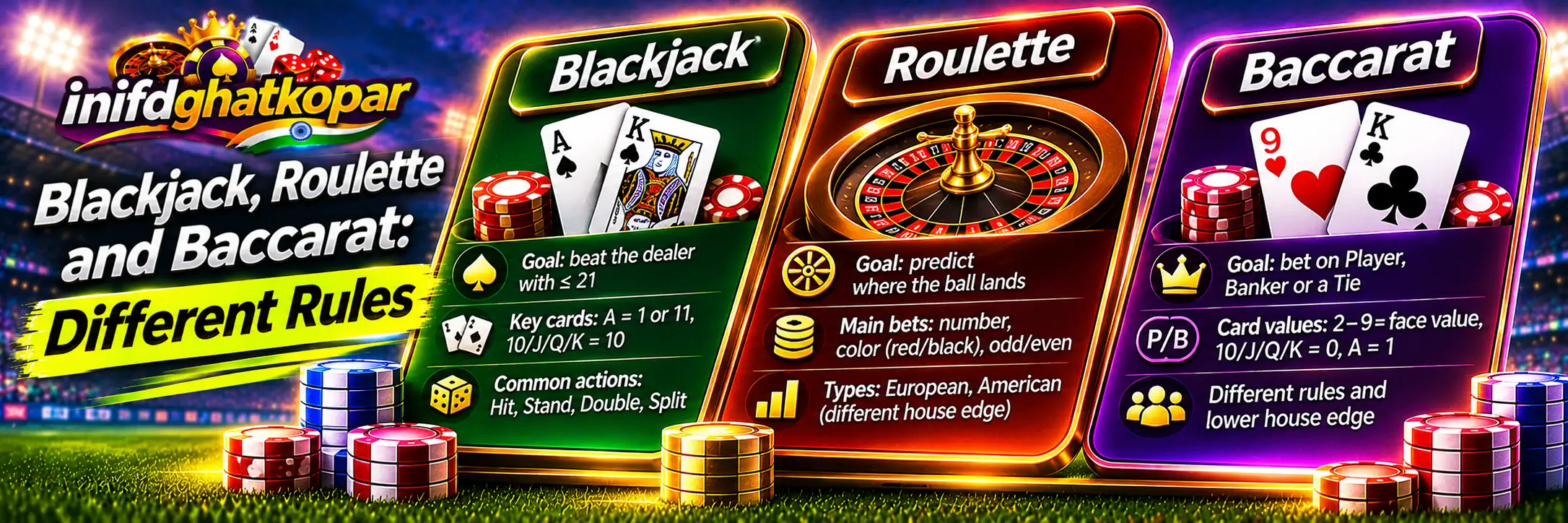
Blackjack is built around card totals. The objective is generally to finish closer to 21 than the dealer without exceeding it, subject to the game's rules. Players may be offered decisions such as hit, stand, double or split.
Those choices influence the outcome probabilities, but the rules determine which decisions are permitted. The number of decks, dealer behaviour and payout for a natural blackjack all matter.
Roulette uses a different structure. A ball lands in a numbered pocket, and bets can cover individual numbers, groups, colours or other combinations. European roulette normally has one zero, while American roulette has both zero and double zero.
That additional pocket changes the mathematical advantage of the house for many standard bets.
Baccarat generally compares two hands, called Player and Banker. The names do not necessarily refer to the people participating. Card drawing follows predefined rules, and the available bets commonly include Player, Banker and Tie.
Different baccarat versions can use commissions or alternative payout rules, so the label alone is not enough to understand the game's expected return.
Teen Patti and Andar Bahar
Indian card games introduce another set of familiar names with rules that can vary between traditional and casino adaptations.
Teen Patti is associated with three-card poker-style hands. Depending on the version, the game may involve hand rankings, betting decisions or a comparison against another hand. Casino variants do not necessarily reproduce every aspect of informal or multiplayer Teen Patti.
Andar Bahar uses a different principle. In common versions, a reference card is revealed and further cards are dealt to two sides until a card of the matching rank appears.
The first side dealt, the exact dealing sequence and the published payouts can influence the mathematical return.
Both games illustrate why a familiar name should not replace reading the rules of the particular version. Side bets, bonus features and alternative payouts may change the result substantially.
House Edge, Payout Rules and Probability
The house edge describes the mathematical advantage built into a game under specified rules and betting conditions.
It is normally expressed as a percentage of total stakes over a sufficiently large number of rounds. It does not predict how much an individual player will win or lose during one session.
Consider the difference between a blackjack paying 3:2 and one paying 6:5 for a natural blackjack. On a winning natural blackjack with a ₹100 qualifying stake, those payout ratios correspond to ₹150 and ₹120 in profit respectively. Other rules also affect the overall house edge.
Roulette provides another useful comparison. With standard even-money bets, a single-zero wheel has a lower house edge than an otherwise comparable double-zero wheel.
In baccarat, a Banker bet may carry commission, while special bets or alternative game variants can use different payout structures.
| Game | Important rule | Why it matters |
|---|---|---|
| Blackjack | Natural blackjack payout | 3:2 and 6:5 produce different returns |
| Roulette | Single zero or double zero | Changes the house edge on standard bets |
| Baccarat | Banker commission and Tie payout | Alters the return for different selections |
| Teen Patti | Hand rankings and variant rules | Determines how outcomes are compared |
| Andar Bahar | Dealing order and payout structure | Affects the probabilities and returns |
Published RTP or house-edge figures should always be associated with a specific game version and rule set.
What Table Game Demos Can Teach
A demonstration version typically supplies virtual credits that can be used to explore the game without staking real funds.
In blackjack, practice can help clarify the sequence of player decisions and dealer actions. In roulette, it can illustrate the difference between straight-up, split, dozen and other available bets.
Baccarat demonstrations can show how hands are resolved and how the third-card rules operate without requiring the player to make those drawing decisions.
The broader collection of free casino demo games also includes slots and crash titles, which use different mechanics.
A demo is most useful for becoming familiar with a game's interface and rules. It does not establish that a particular betting system will produce a profit.
Not every game has an independently accessible demo, and demonstration versions may differ in available features, bet limits or mathematical settings.
Digital Table Games and Live Dealer Casinos

A digital table game generally uses software to display and resolve outcomes. Some are based on virtual cards or animated wheels, while others reproduce traditional casino layouts.
Live dealer games instead use streamed tables and human dealers. Depending on the provider, players may see real cards, physical roulette equipment and a video feed from a studio.
These formats can share basic rules without being identical products.
Live games may introduce additional betting limits, session schedules, side bets, streaming requirements or other conditions.
A digital demonstration does not necessarily reproduce the timing or interaction of a live dealer table.
For readers comparing platforms, online casino reviews may identify which operators publish particular types of casino games and providers. However, the presence of a studio or game name is not proof of an operator's reliability or legal authorisation.
Casino Bonuses and Table Game Restrictions
Casino promotions often distinguish between different game categories.
A bonus may apply to selected slots while excluding blackjack, roulette or baccarat. Other offers assign lower wagering contributions to table games or prohibit certain betting strategies.
For example, a promotional turnover requirement might count only a fraction of a blackjack stake towards the required amount. The precise percentage depends on the published promotion.
The existence of a table game in a casino does not establish that it qualifies for every available offer.
Published casino bonus offers should therefore be checked for eligible games, wagering conditions, maximum bet limits and withdrawal restrictions.
Demo credits are separate from promotional funds. A virtual-credit table game does not normally create withdrawable winnings or demonstrate whether an operator will honour a bonus claim.
Understanding Strategy and Financial Risk
Some table games allow decisions that influence their mathematical outcomes.
Blackjack is a familiar example. Choosing when to hit, stand, double or split can affect expected returns under a specific rule set. A strategy suited to one version may be inappropriate for another.
This does not mean that a particular strategy guarantees winning results.
Roulette and standard baccarat generally offer much less scope for decisions that change the underlying probabilities. Previous spins or hands do not make a particular outcome due when rounds are independent.
Systems that increase stakes following losses do not eliminate the house edge. They can instead expose a player to increasingly large losses.
Information about responsible play remains relevant even when exploring games through demonstrations. Virtual-credit sessions can explain the mechanics, but they do not reproduce the financial pressure associated with real-money gambling.
Table demos are tools for understanding games, not methods for guaranteeing a profitable outcome.