
Crash games turn a simple mathematical idea into a fast-moving casino format. A multiplier increases during a round, and the central question is whether a cashout happens before the game ends. The longer a multiplier rises, the larger the potential payout becomes — but the chance of losing the stake remains.
Free crash demos allow these mechanics to be explored with virtual credits rather than real money. They can help explain timing, automatic cashout settings and differences between game formats. What they cannot do is predict future outcomes or establish a reliable winning strategy.
The wider category of fast-paced casino games also includes titles such as Mines, Plinko and Coin Flip. These may share short rounds and multiplier-based payouts without using the traditional rising-multiplier crash mechanic.
How Crash Multipliers Work
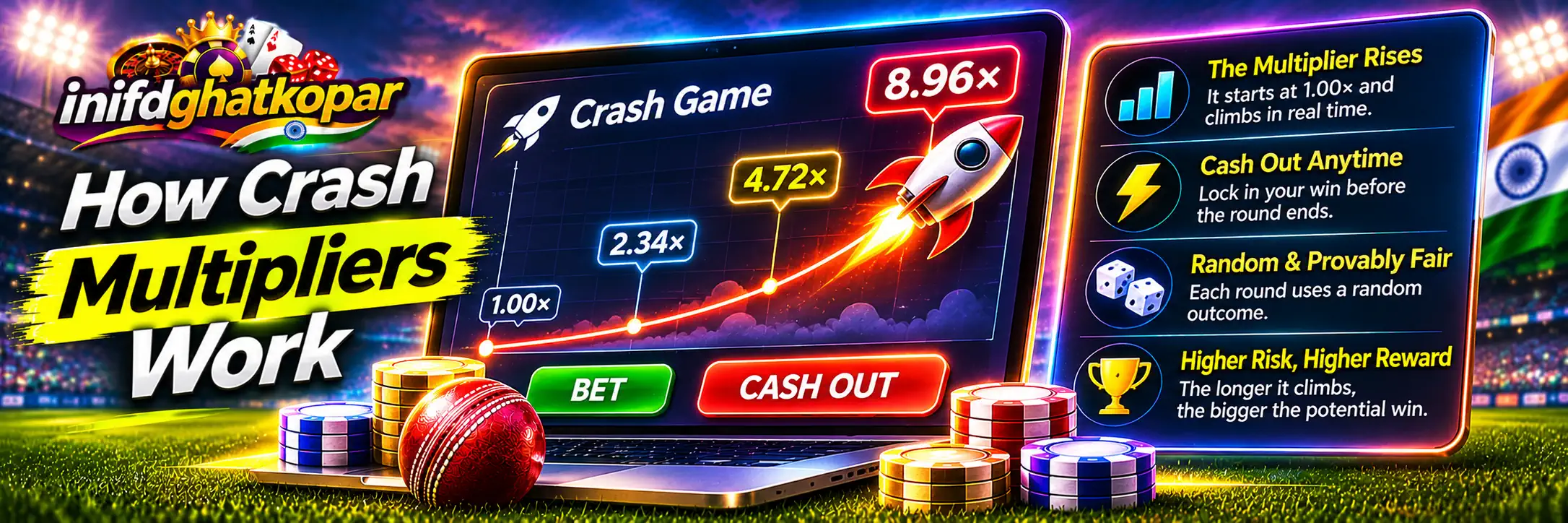
A conventional crash round starts with a multiplier that increases from its initial value. The game ends at an unpredictable point, commonly described as the crash.
A successful cashout must occur before that point. If the round ends first, the stake is lost under the game's applicable rules.
For example, a theoretical ₹100 stake cashed out successfully at 2.00x would produce a total payout of ₹200, including the original stake. If the crash happens before cashout, the payout for that stake would normally be zero.
This example explains the calculation, not the probability of obtaining a particular multiplier.
Different providers may display the same basic process through rockets, aircraft, charts or other visual themes. The underlying payout rules, available controls and mathematical configurations can still differ.
Aviator, JetX and other multiplier games should therefore be evaluated according to their individual rules rather than assumed to be mathematically identical.
Manual Cashout and Automatic Cashout
Some crash games offer manual cashout, allowing a player to choose when to end an active bet. Others include an automatic cashout option, which attempts to close a bet at a selected multiplier.
Neither feature guarantees that a particular round will reach the desired value.
An automatic cashout setting describes an instruction to the game. It does not change the probability distribution of future crash points.
There may also be practical differences between providers involving timing, connection interruptions, accepted bets or how cashout requests are processed.
Demo versions are useful for understanding the visible controls, but they should not be treated as proof that every real-money implementation handles timing and network conditions identically.
Can Previous Crash Results Predict the Next Round?
A common mistake is to interpret previous multipliers as evidence of what must happen next.
Several low crash points do not establish that a high multiplier is due. Equally, a run of unusually large multipliers does not prove that the next round must end early.
Where rounds are generated independently, previous outcomes do not alter the probability distribution of the next one.
Some providers describe their games as using provably fair systems, random number generators or other verification methods. These claims must be examined in relation to the specific game and its published technical documentation.
A visible history of multipliers is not, by itself, evidence that future results can be predicted.
The same principle applies to betting systems that increase stakes after losses. Such methods change the amount at risk but do not remove the mathematical advantage built into a casino game.
Crash Games and Other Instant-Win Formats
Not every fast-paced casino title uses a continuously rising multiplier.
Some games rely on selecting hidden positions, revealing symbols or choosing an outcome from a set of possibilities. Others use a multiplier that is determined without a manual cashout phase.
| Game format | Typical mechanic | Important distinction |
|---|---|---|
| Traditional Crash | Rising multiplier until the round ends | Cashout timing can affect the outcome |
| Limbo-style games | Target multiplier or outcome comparison | May not include a live rising curve |
| Mines | Revealing positions while avoiding losing symbols | Risk changes with selections and rules |
| Plinko | Ball or token follows a path to a payout position | Outcome depends on the game's mathematical model |
| Coin Flip | Selection between possible outcomes | No conventional rising crash multiplier |
These formats can appear together in instant-game collections because their rounds are relatively short. However, their rules and probabilities are not interchangeable.
The presence of a game in a Crash or Instant category should not be interpreted as proof that it uses the classic crash mechanic.
RTP, House Edge and Risk
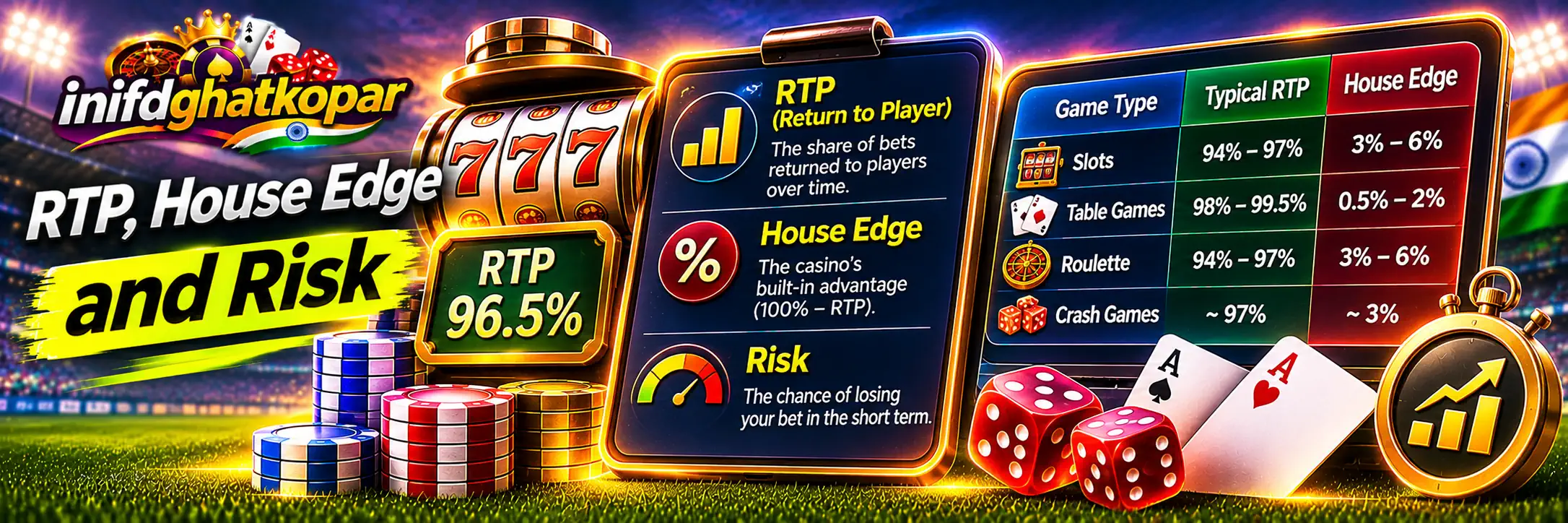
Return to Player, or RTP, describes the theoretical percentage of stakes returned over a very large number of game rounds.
A hypothetical RTP of 97% corresponds to a theoretical house edge of 3% under the relevant mathematical model. It does not imply that a player will receive ₹97 back from every ₹100 staked.
Crash games can produce substantial differences between individual sessions. A small number of high multipliers may have a large effect on visible results, while many rounds may end before a chosen cashout level.
Higher potential multipliers generally involve lower chances of successful cashout under conventional crash models. The exact relationship depends on the game's design.
The mathematical characteristics of one crash title should never be assigned automatically to another game, even when their interfaces appear similar.
Published RTP figures, where available, should be checked against the relevant game version and provider documentation.
What Free Crash Demos Can Teach
A demonstration game offers a way to become familiar with controls without staking real money.
Virtual credits can illustrate how bets are placed, how multipliers change and how a successful or unsuccessful cashout affects the displayed balance.
Some demos allow the balance to be replenished or the session to be restarted. The credits are simulated and cannot normally be withdrawn.
The availability of public demos varies by provider. A game being available in demo mode does not mean that every operator offers the same title or configuration.
Readers exploring other game formats can find slots and table games among the wider collection of free casino demo games.
The demo experience is educational, but it has clear limitations. Practice results do not verify casino payment reliability, withdrawal conditions or an operator's legal status.
Crash Games, Bonuses and Operator Conditions
Some casino promotions include crash or other instant games, while others exclude them entirely.
Bonus terms may specify eligible titles, game contribution percentages, maximum bet amounts or separate wagering requirements.
A game accepting ordinary bets does not necessarily contribute towards promotional turnover.
Published casino bonus offers should therefore be examined separately from the game mechanics themselves. A bonus percentage cannot establish whether a particular crash title qualifies.
Operator policies also matter. The same game studio may distribute titles through several platforms with different account, verification or payment conditions.
An online casino directory can provide information about operators and their published characteristics, but that information should not be confused with a guarantee of financial or legal reliability.
Understanding the Limits of Practice Play
A demo can help explain how a game operates. It cannot eliminate uncertainty or establish a dependable method for winning money.
Fast rounds may encourage frequent decisions, particularly when multipliers and results change rapidly. The ability to restart a virtual-credit balance can also make losses feel less significant than they would in paid play.
That difference is worth recognising before drawing conclusions from a practice session.
Information about responsible play is relevant to all chance-based casino products, including crash games. Financial limits, realistic expectations and an understanding of randomness matter more than attempts to identify patterns in short result histories.
Crash demos are tools for exploring game mechanics, not forecasts of profitable real-money outcomes.