
1
- Featured
- Casino
- Sports
- Teen Patti
- TablesCasino · Sports · Teen Patti
- WelcomeUp to 700% bonus for sport
PaymentsUPI · Paytm · PhonePe
UPI · Paytm · PhonePe · Google Pay
- AppAndroid
- SupportLive chat

Casino brands
122 brands · 1 of 13
1
UPI · Paytm · PhonePe · Google Pay

2
100% up to ₹25,000
10% Monday cashback
Refer a friend ₹500
UPI · Paytm · PhonePe · Google Pay · Visa · Mastercard · Bank transfer
Live chat · 1800 212 9017 · [email protected] · WhatsApp

3

4
700% Welcome Pack (100% / 150% / 200% / 250% on 1st–4th deposits)
Get 100% deposit bonus

5
Welcome pack: up to ₹1,50,000 + 430 FS on first 5 deposits
Cashback up to 20%
UPI · Paytm · PhonePe · iCash.One

6
UPI · IMPS · icash.one · INB · BTC · ETH · USDT · Bank transfer

7

8

9
BTC · ETH · USDT · LTC

10
UPI · PhonePe · Paytm · Mobikwik · BTC
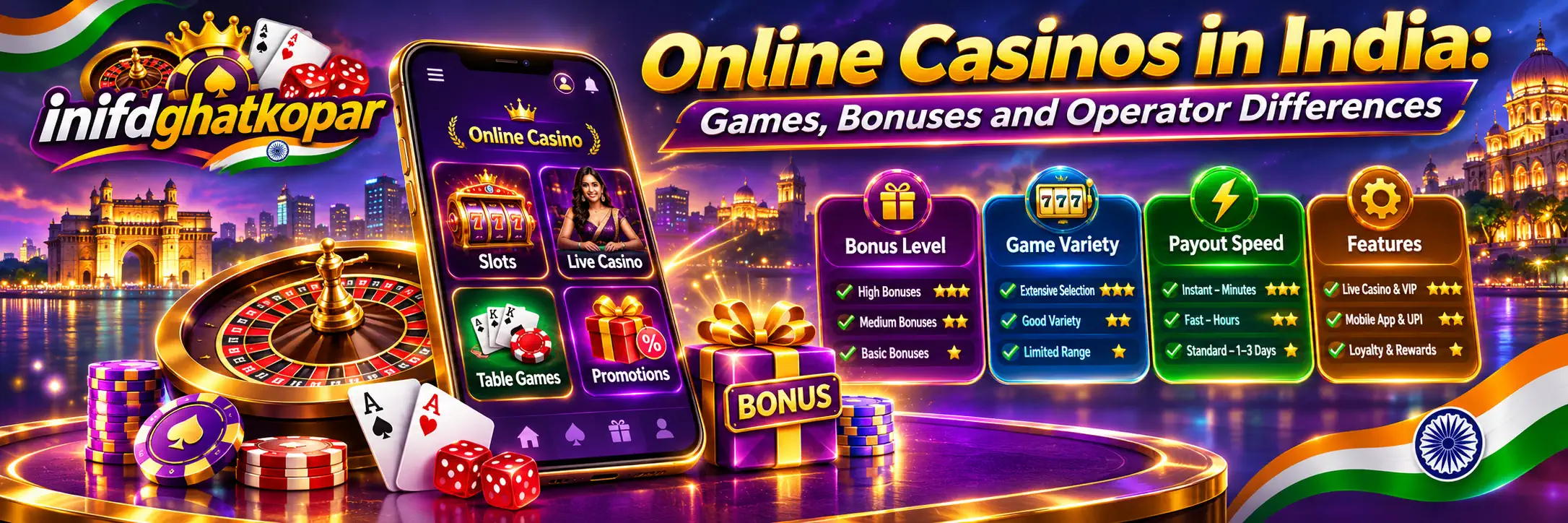
Online casinos can look surprisingly similar at first glance. Colourful slot lobbies, familiar table games and large welcome offers appear across numerous operators. The differences become more noticeable when examining the actual game catalogue, software providers, account conditions and withdrawal policies.
For anyone researching casino brands associated with the Indian market, it is worth separating what an operator advertises from what can be independently verified. A long game list does not establish fairness, a large bonus does not guarantee a useful offer, and the availability of an INR payment method says nothing by itself about regulatory authorisation.
Casino platforms commonly organise their games into several categories, each with different mechanics and playing conditions.
Slots use predefined mathematical models to determine outcomes and payouts. They can feature fixed paylines, expanding reels, bonus rounds or progressive jackpots. Two slots with similar themes may behave very differently because their volatility, bonus frequency and return-to-player settings are not necessarily the same.
Traditional table games include roulette, blackjack, baccarat and various poker-based casino games. Their rules matter. A blackjack table paying 6:5 for a natural blackjack is mathematically different from one paying 3:2, even when the rest of the interface looks identical.
Live casino games introduce human dealers and streamed tables. Players may encounter live roulette, baccarat, blackjack or game-show formats. Streaming quality, table limits and available betting options can differ between operators and studios.
Crash games follow another model: a rising multiplier ends at an unpredictable point, and the player must decide whether to cash out beforehand. A high multiplier displayed in a previous round does not predict the next outcome.
Readers who want to explore mechanics without depositing money can use free casino demo games where such versions are available. Demo play can illustrate rules and interfaces, but it does not make paid play financially safer.
Game studios are an important part of understanding a casino's catalogue.
Some developers specialise in video slots. Others focus on live dealer tables, traditional casino games or newer instant-win formats. An operator may integrate titles from several providers, while another relies on a smaller group of studios.
The presence of a recognised studio is useful information, but it does not prove that every game is identical across all casinos. Games may have configurable RTP versions, regional restrictions or different available betting limits.
It is also worth distinguishing the game provider from the casino operator. The studio develops or supplies the game; the operator controls the account relationship, payment arrangements and many of the conditions affecting access.
Provider information should therefore be considered alongside the operator's own policies, rather than treated as a substitute for them.
Return to Player, usually abbreviated RTP, describes the theoretical proportion of stakes returned by a game over a very large number of plays.
For example, a theoretical RTP of 96% corresponds to a 4% house edge under the relevant mathematical model. It does not mean that a player depositing ₹1,000 should expect to receive ₹960 back during a particular session.
Results can vary considerably in the short term. One player might win, another might lose the full stake, and neither outcome contradicts the theoretical RTP.
Volatility describes another characteristic: how wins tend to be distributed. Higher-volatility games generally produce less frequent but potentially larger payouts, while lower-volatility games tend towards smaller, more frequent results. Neither removes the underlying house advantage.
| Game characteristic | What it describes | What it does not guarantee |
|---|---|---|
| RTP | Theoretical long-term return | A fixed return in one session |
| Volatility | Distribution of payouts | A predictable winning sequence |
| House edge | Mathematical advantage built into the game | The result of an individual bet |
| Maximum payout | An upper limit under specified conditions | A realistic expected win |
| Demo mode | Gameplay without real-money stakes | Identical account conditions everywhere |
These concepts are often misunderstood because casino advertising naturally emphasises large prizes rather than the mathematics behind them.

Casino promotions commonly include deposit matches, free spins, cashback or rewards tied to particular games. The advertised value is only one part of the offer.
A percentage bonus may have a maximum qualifying amount. Free spins might apply to selected slots, produce winnings with withdrawal restrictions or expire before they can be used.
Wagering requirements are particularly important. A requirement of 30x, for instance, can refer to the bonus amount alone or to the deposit and bonus combined. Those two calculations produce different turnover obligations.
Other conditions may include maximum bet limits, excluded games, game contribution percentages and restrictions on withdrawing before a promotion is completed.
Our separate catalogue of casino bonus offers provides published promotional information associated with individual operators. Those offers may change, especially during sporting events, seasonal campaigns or short-term promotions.
Always consult the operator's current terms before relying on a promotional figure. An unusually large headline offer is not evidence of favourable conditions.
Payment arrangements are another area where apparently similar casinos can differ substantially.
Indian-facing operator websites may advertise INR amounts, UPI, bank transfers, cards, wallets or digital assets. The availability of any method depends on the operator and the applicable restrictions.
A payment method listed on a website does not necessarily support both deposits and withdrawals. Processing times may also include separate stages for operator approval, payment provider handling and bank settlement.
cryptocurrency casino payments introduce additional considerations involving wallet addresses, supported blockchain networks, exchange rates and transaction fees.
Account verification deserves equal attention. Operators may request identity documents, payment ownership evidence or additional information before processing certain withdrawals.
Players should not assume that a successful deposit establishes withdrawal eligibility. Transaction limits, verification requirements and account restrictions can apply independently.
India's regulatory environment for online gaming changed significantly with the Promotion and Regulation of Online Gaming Act, 2025, and its implementing rules. The framework prohibits online money games as defined by the legislation and distinguishes them from permitted categories such as certain social games and e-sports.
A gambling website being accessible from India does not establish that it is legally authorised to offer real-money gaming services there.
An offshore licence, where one is claimed, should be assessed in relation to the issuing jurisdiction and independently verified. It must not be presented as automatic permission to serve Indian users.
A useful operator review should identify what is known, what the operator claims and what remains unverified. Company information, published policies, dispute procedures and clear account terms are more meaningful than unsupported statements about safety or trustworthiness.
There is no single feature that makes one casino suitable for every visitor.
A large slot collection may matter to someone researching game availability, while another reader may be more interested in live tables, software providers or the clarity of an operator's published policies.
A wider casino and sportsbook directory can help identify which operators offer different combinations of products. However, a category label is only a starting point for research.
The most useful comparisons focus on verifiable differences: game providers, payment restrictions, bonus conditions, published ownership information and customer support arrangements.
Marketing claims deserve scrutiny, particularly when they promise unusually high returns, effortless withdrawals or guaranteed outcomes.
Casino games involve financial risk when real money is staked. No bonus, game strategy or payment technology eliminates that risk.
Slots use software-driven game mechanics, while live casino games typically stream tables operated by human dealers. Both can involve chance, but their interfaces, rules, betting limits and playing experience differ.
No. RTP is a theoretical long-term measure, not a guarantee for individual sessions. A higher RTP may indicate a smaller mathematical house edge under the stated conditions, but losses remain possible.
Not necessarily. Promotional funds or winnings may be subject to wagering requirements, game restrictions, maximum bet rules or time limits. Conditions differ between operators and individual offers.
No. Payment availability varies by operator and applicable restrictions. Even where UPI appears as a deposit option, withdrawals may use different methods or require additional verification.
No. An offshore licence does not override Indian law. The Promotion and Regulation of Online Gaming Act, 2025, and applicable rules must be considered when assessing real-money gaming services offered to users in India.