
A payment logo on an operator's website can make a transaction look simple. UPI, bank transfer, card payment or wallet: select a method, enter an amount and continue. But the name of a payment method does not reveal every condition attached to it.
The provider may support different transaction types, the operator may apply separate account requirements, and the payment method displayed during registration may not be available when a withdrawal is requested.
For readers in India, understanding the distinction between the banking transaction and the operator's account balance is particularly useful.
UPI, Bank Transfers and Other Payment Methods
UPI, or Unified Payments Interface, is an Indian payment system that allows supported payment applications and bank accounts to initiate electronic transfers.
A UPI transaction may use a payment address, QR code or supported in-app payment flow. The actual process depends on the participating application, bank and payment arrangement.
UPI should not be confused with a conventional bank transfer simply because both may involve funds held in a bank account.
IMPS, NEFT and other bank transfer systems have their own processing arrangements, availability requirements and payment references.
Cards and digital wallets introduce additional distinctions. Their use may depend on the issuer, acquiring provider, account type and the nature of the transaction.
An operator displaying a payment method does not establish that every user can use it.
Availability may differ according to location, account eligibility, payment provider restrictions or the operator's current arrangements.
The same principle applies to crypto casino listings. A brand appearing in a crypto category does not prove that every cryptocurrency, blockchain network or payment method is currently supported.
Deposits and Withdrawals Are Separate Processes
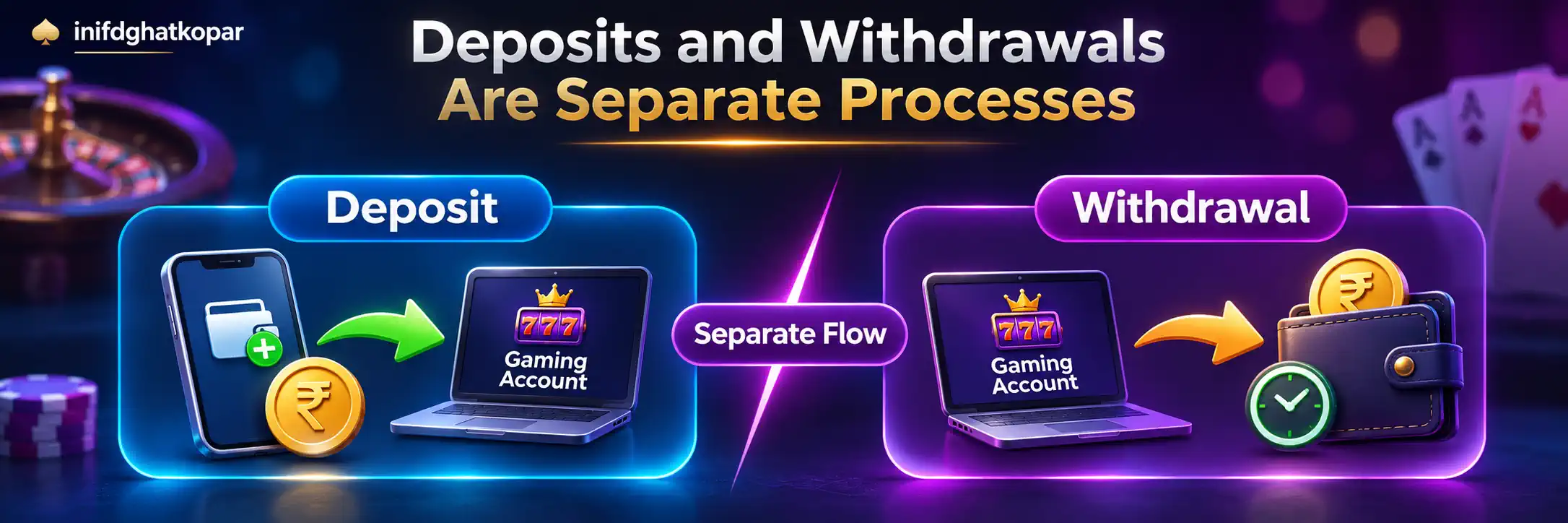
A deposit and a withdrawal are not simply the same transaction moving in opposite directions.
A deposit generally involves sending funds to an eligible recipient and waiting for the operator to recognise the payment in the customer account.
A withdrawal involves the operator processing a request to release an eligible balance through an available payout arrangement.
The payment rails used for these processes can differ.
For example, an account might display one payment method for deposits while offering a different method for withdrawals.
Verification may also be required before a payout can be processed.
A successful payment notification from a bank or app does not necessarily mean that the operator has completed its separate account-crediting process.
Likewise, a withdrawal marked as approved by an operator does not automatically establish that the receiving bank has credited the payment.
These stages should be considered separately whenever a transaction appears delayed.
Payment Methods Compared
Payment methods differ in how they are initiated, confirmed and handled when difficulties arise.
| Payment method | General characteristics | What needs checking |
|---|---|---|
| UPI | Supported app and bank-account payment flows | Recipient, transaction status, provider restrictions |
| IMPS | Bank transfer mechanism | Recipient details, bank support, transaction conditions |
| NEFT | Bank transfer through participating institutions | Processing arrangements, beneficiary details |
| Cards | Payment through a card issuer and acquiring network | Card eligibility, restrictions, fees and refunds |
| Digital wallets | Transactions through an eligible wallet provider | Account status, supported transaction types |
| Cryptocurrency | Transfers through supported blockchain networks | Asset, network, address and confirmation requirements |
This table explains general differences, not a list of payment methods confirmed for every operator.
Some providers may restrict particular transactions or industries.
The actual payment options shown inside a legitimate account interface may change independently of promotional descriptions on external websites.
For that reason, an online casino directory should be used to research recorded information, not as confirmation that a particular transaction will be accepted.
Minimum Deposits, Fees and Processing Conditions
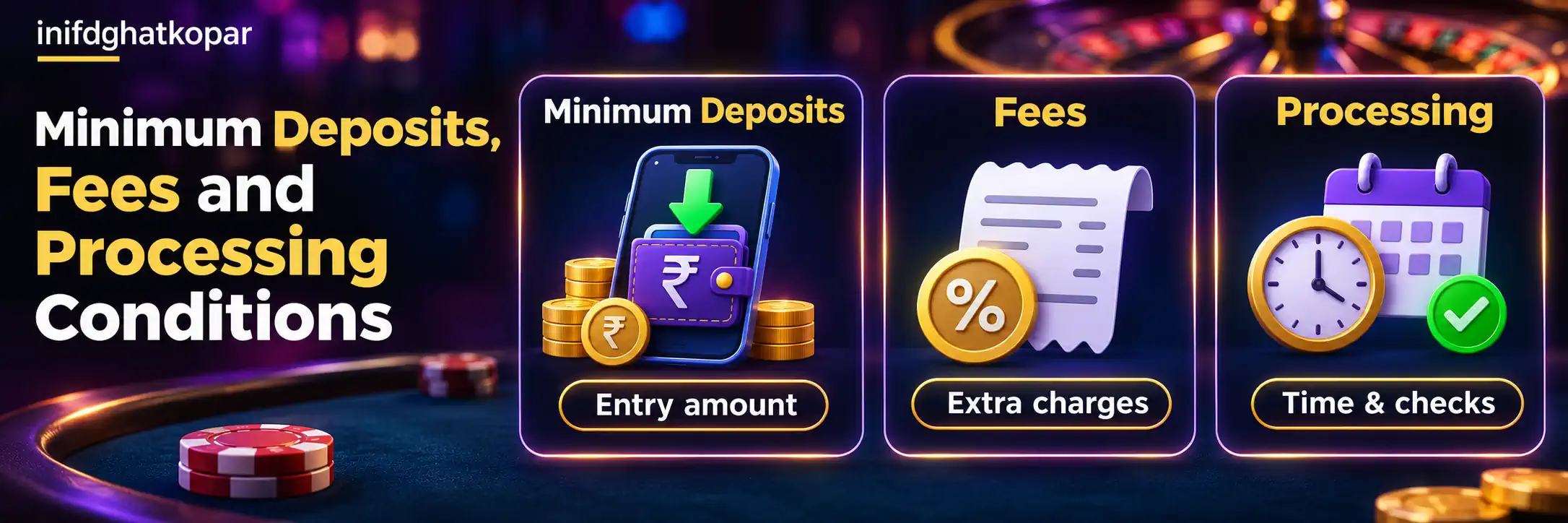
Transaction conditions can differ considerably between payment methods and operators.
An operator may specify a minimum deposit, a maximum transaction amount or a different withdrawal threshold.
Fees can arise from more than one source. The operator, bank or payment provider may apply conditions that affect the final amount received.
Currency conversion can introduce additional costs when a transaction involves different currencies.
Processing times also deserve careful interpretation.
An electronic payment system may process an instruction quickly, while account verification, reconciliation or payout review can take longer.
A statement that a method offers instant transfers should not be interpreted as a promise of instant operator withdrawals.
Short operator summaries may omit fees or transaction limits.
Missing values should remain unknown until confirmed through current published terms.
Pending Transactions, Failed Payments and Refunds
Digital payments do not always complete immediately or display the same status across every system.
A transaction may be shown as pending while the payment provider determines whether it has completed.
A failed transaction may require a reversal or refund under the relevant payment system's rules.
A bank debit without an immediate operator account credit needs particular care because the two records can become temporarily inconsistent.
A useful first distinction is whether the payment provider regards the original transaction as successful, pending or failed.
Transaction references, timestamps and statements can help identify a specific payment when communicating with the relevant bank or provider.
The rules and procedures for disputing a failed bank payment are not necessarily the same as requesting a refund or withdrawal from a gambling operator.
Do not assume that a payment can be reversed simply because the recipient is disputed.
Official bank and payment-provider procedures should be used when investigating transaction problems. Sensitive credentials, one-time passwords and payment PINs should never be shared with someone claiming they are needed to release a refund.
Account Verification and Withdrawal Eligibility
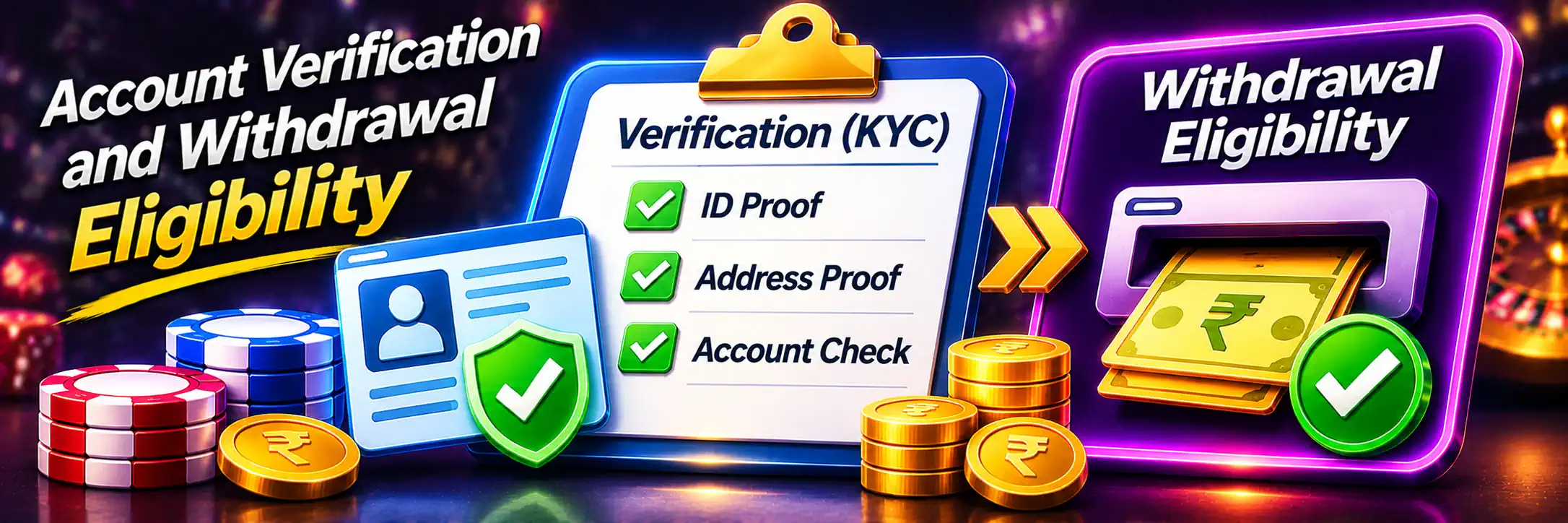
Payment availability may depend on account verification.
An operator might require identity or payment-related checks before processing withdrawals, subject to its published policies and applicable requirements.
Such checks can be separate from promotional conditions.
An account balance may also include funds that are not yet eligible for withdrawal because of bonus wagering requirements or other restrictions.
For example, casino bonuses may allocate promotional credit that is subject to game eligibility rules and qualifying turnover.
An account showing a positive balance therefore does not necessarily establish that the entire amount is withdrawable.
Neither a payment method advertised on a site nor a screenshot of a previous transaction proves that the same process will be available to every account.
Users should distinguish confirmed current terms from older promotional material and incomplete summaries.
Payment Information, Regional Restrictions and Risk
Payment methods and gambling services are governed by different sets of conditions.
A widely used banking method is not automatically available for gambling-related payments. Banks, payment providers and operators may restrict certain transaction types.
Likewise, the presence of a payment logo does not establish that an operator is legally authorised to offer gambling services in India.
Restrictions can differ by jurisdiction, provider and account.
Another important issue is financial risk.
Easy electronic payments can make repeated deposits feel routine, even though the underlying gambling activity remains uncertain.
Understanding responsible play includes setting financial boundaries independently of promotional offers or payment convenience.
The practical approach is to examine the operator's current information, verify payment details through the appropriate provider and avoid assuming that a listed payment method guarantees a successful deposit, withdrawal or refund.